 18+
From the first click to a settled result
Check the session
Confirm the game title, provider and whether the balance is virtual or real. Use the mode label and account context; a round balance such as 1,000 is not proof of demo mode.
Set the stake before the round
The stake is the amount committed to this round. It is separate from the full wallet balance. Check the permitted range in the game rather than importing a minimum from another casino.
Select the difficulty
The original provider page lists Easy, Medium, Hard and Hardcore. Compare the settings in free play and read their rules. A difficulty label is not a promise that a round will survive.
Read the current collection amount
After a successful step, decide whether to collect what is available or continue. Each further move leaves the round exposed to a losing result.
Confirm settlement
A completed cash-out closes that round. A losing step loses its stake. Check the balance and history before assuming the animation has settled.
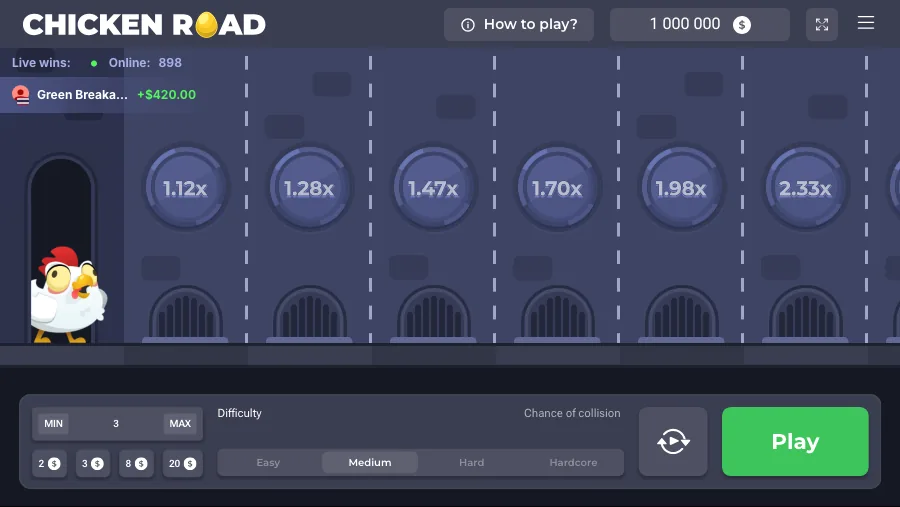
Six things worth locating on the screen
| Item | Read it as | Do not confuse it with |
|---|---|---|
| Wallet balance | Credits available in the session | The amount staked on one round |
| Stake | The amount at risk for this round | A guaranteed return |
| Difficulty | The selected risk configuration | A skill level that guarantees success |
| Multiplier | A factor applied to the stake | Profit after subtracting the stake |
| Cash out | Collect the current round’s offered return | A bank or wallet withdrawal |
| History / round ID | A record for checking settlement | A prediction of the next result |
If a control is unclear, pause and open the help panel. Button positions and translations can differ between devices and versions. Learn the meaning instead of memorising where a coloured rectangle appeared in a screenshot.
An example with a 10-unit virtual stake
Suppose a demonstration round offers a collection at 1.50×. A 10-unit stake would return 15 units in total if collection completes at that multiplier. The net result is +5 units because 10 of the 15 units are the original stake.
If you continue instead and the round loses, the net result is −10 units. The earlier 15-unit offer was not a separate amount already paid into your wallet. This distinction is why it is misleading to add every multiplier seen along the road as though each one were a separate win.
The numbers here are an arithmetic example, not a claim that 1.50× appears at a specific step or difficulty. Use the calculator to examine other totals without assigning invented probabilities to them.
Difficulty, timing and maximum returns
Higher potential returns should be read alongside the risk of failing to reach them. Do not assume that two modes have the same number of steps, the same multiplier sequence or the same limits. The rules in the opened game are the place to confirm those details.
We do not publish one universal maximum win, stake range or number of lanes for every Chicken Road session. A product title, operator configuration and account restrictions can affect the limits that matter to you. A promotional “×1000” on artwork is not a payout commitment.
Watching traffic, tapping to a rhythm or waiting for a particular clock time does not establish a repeatable advantage. This is a gambling game with chance-based outcomes, not a reaction test that guarantees survival when played skilfully.
If a round freezes or a click seems unanswered
A connection interruption leaves two questions: did the request reach the game, and what result was recorded? Repeatedly pressing controls cannot reliably answer either. Check the history and balance after reconnecting, then record the game title, round ID, approximate time and what the screen showed.
For a disputed paid round, use the operator’s authenticated support channel. Do not send account passwords or one-time login codes in a chat message. A withdrawal problem belongs to the cashier; a missing round settlement needs the round record. See payments and troubleshooting for that distinction.
Practise these checks in the free demo. On a phone, browser and screen-orientation guidance can make small controls easier to read.
Questions people ask
5 / FAQNo matching questions. Try another word.
What happens if the chicken loses?
The round ends and its stake is lost. Multipliers that were displayed before a completed cash-out are not separate winnings already collected.
Is cash out the same as withdraw?
No. Cash out settles a game round. Withdraw requests a transfer from an operator account through its cashier.
What difficulty modes does the original list?
InOut lists Easy, Medium, Hard and Hardcore for the original. Read the rules in the session you open before assuming settings are identical across versions.
Does faster tapping improve the odds?
There is no verified basis here for treating tapping speed or traffic timing as a way to guarantee a favourable result.
What should I save if a round is disputed?
Keep the title, operator, round ID, timestamp and relevant screen record. Use authenticated support and never share passwords or one-time codes.