 18+
Calculate the return, not the next result
What does a multiplier actually pay?
Illustrative arithmetic, not a forecast. Cash-out total includes the stake.
Enter a stake above 0 and a multiplier of at least 1.
Total = stake × multiplier. Net result = total − stake.
Use any hypothetical stake and multiplier to see the difference between total return and net profit. The losing outcome remains the negative stake. A displayed positive result does not include a probability of reaching that multiplier, transaction fees, bonus restrictions or an operator’s payment limits.
| Stake | Collected at | Total return | Net result |
|---|---|---|---|
| 10 | 1.2× | 12 | +2 |
| 10 | 2× | 20 | +10 |
| 10 | 5× | 50 | +40 |
| 10 | Round lost | 0 | −10 |
RTP is about turnover, not your next session
InOut publishes 98% for the original and 95.5% for 2.0. Their theoretical edges are therefore 2% and 4.5%. Over an illustrative 1,000 units staked, the corresponding theoretical losses are 20 and 45 units. These are long-run mathematical averages, not a limit on what one person can lose.
A deposit and turnover are different quantities. Stake the same returned 10 units ten times and total stakes reach 100. Small repeated wagers can therefore create substantial turnover without a new deposit each time. Reducing a stake limits the amount exposed in one round; it does not convert a negative-expectation game into income.
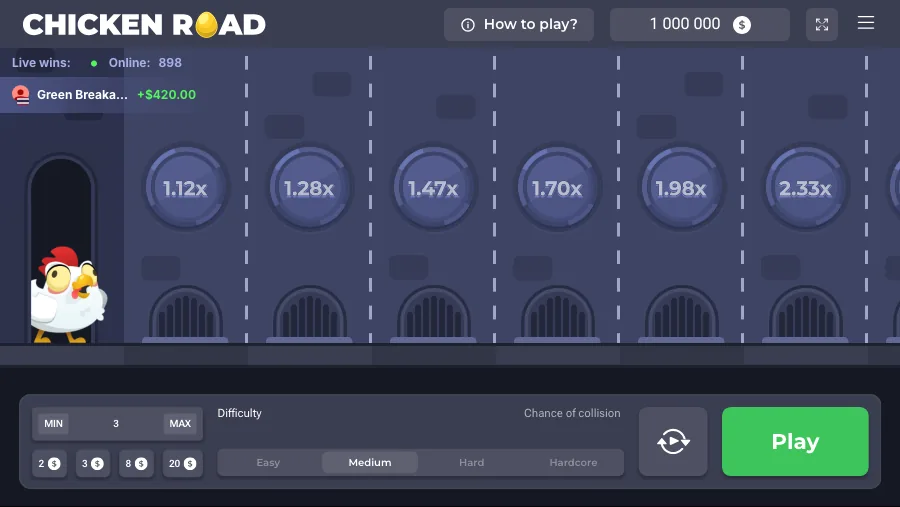
Nor is 98% RTP a 98% chance to win each round. The chance of reaching a particular step needs the actual game probabilities. We do not infer a universal survival table from a multiplier screenshot or assign an invented equal risk to every lane.
Why common betting systems do not remove risk
Doubling after a loss
Starting at 1 unit and doubling after each loss gives stakes of 1, 2, 4, 8, 16 and 32. Six losses cost 63 units; the next proposed stake is 64. A finite balance or table limit stops the sequence. At low cash-out multipliers, a single later win may not even recover the earlier losses under the simple doubling rule.
Collecting early
A lower target changes the size and frequency of returns compared with pursuing later steps. It is not a guarantee of profit. For a simplified example paying exactly 1.2×, one 10-unit loss needs five successful 10-unit collections at +2 each merely to break even. This example illustrates accounting; it is not the game’s probability table.
Waiting for a pattern
A sequence of past results does not demonstrate that the next round is due to win. A screenshot of a few successful predictions lacks the missed predictions, sample size and independent verification needed to support a reliable method.
Hacks, bots and prediction apps
A third-party app cannot prove future results simply by displaying a countdown, coloured arrows or a “confidence” percentage. This guide has no verified predictor to recommend. Be especially cautious when access is tied to a deposit, a paid activation, a private messaging group or sharing a login.
Separate an automation tool that clicks a button from a tool that claims knowledge of a future outcome. Automating clicks does not establish predictive access and may conflict with an operator’s rules. A modified APK also introduces a separate software-security risk.
If a service says it can recover losses for an upfront fee, stop and verify who operates it. Do not provide passwords, one-time codes or remote access to a device. For a broader authenticity check, use real or fake; for suspicious installers, see app and APK guidance.
A plan should define when to stop
Before any real-money session, decide a spending ceiling and a time limit you can afford to keep. Do not count a hoped-for win as money available for essentials. A loss limit is a stopping rule, not a statement that losing that amount is inevitable or safe for everyone.
Changing the limit because a win feels close defeats its purpose. If stopping is difficult, use account limits or self-exclusion where available and seek gambling support. The virtual-credit demo can explain controls without making a financial commitment.
For the precise distinction between the two published RTP figures, read the original and 2.0 comparison. For how a displayed return becomes an operator balance, start with the round walkthrough.
Questions people ask
5 / FAQNo matching questions. Try another word.
Is there a guaranteed Chicken Road strategy?
No strategy on this page guarantees a win or eliminates the possibility of losing a session budget. The calculator only performs payout arithmetic.
Does 98% RTP mean I can lose only 2%?
No. It is a theoretical long-run return on cumulative stakes. A short session can lose far more, including the entire amount committed.
Can the calculator predict a safe step?
No. It calculates stake × multiplier and subtracts the stake. It does not know the next outcome or the chance of reaching a step.
Does doubling after a loss solve the problem?
No. The required stakes grow rapidly, balances and limits are finite, and the game’s underlying risk remains.
Are paid predictors verified here?
No. A displayed success rate, a video or a private-group testimonial is not independent evidence of reliable prediction.